NETWORK ARCHITECTURE
WHAT IS NETWORK ARCHITECTURE???
The configuration of computers, devices and media on a network.
CATEGORIES OF NETWORK ARCHITECTURE
PEER TO PEER NETWORK

The configuration of computers, devices and media on a network.
CATEGORIES OF NETWORK ARCHITECTURE
- PEER TO PEER NETWORK
- CLIENT SERVER NETWORK
PEER TO PEER NETWORK
- A simple, inexpensive network that typically connects fewer that 10 computers.
- Each computer, called a peer, has equal responsibilities and capabilities.
- Sharing hardware( such as printer), data or information with other computers on the peer to peer network.
- Each computer stores files on its own storage devices. Thus, each computer on the network contains both the server operating system and application software.
- All computers on the network share any peripheral device(s) attached to any computer.
- Peer to peer networks are ideal foe every small businesses and home users.
- Some operating systems, such as Windows, include peer to peer networking that allows users to set up a peer to peer network.
- Peers are both suppliers and consumers of resources.
- Each node is a computer on the network which acts and communicates with other Peers to make a portion of theirs resources, such as processing power, disk storage or network bandwidth.
- Directly available to other network participants, without the need for central coordination by servers or stable hosts.
peer-to-peer network
CLIENT SERVER NETWORK
- One or more computers act as a server, and other computers on the network request services from the server.
- Server, sometimes called a host computer, controls access to the hardware, software, and other resources on the network and provides a centralized storage area for programs, data and information.
- The clients are other computers and mobile devices that rely on the server for its resources.
- For example, a server might store a database of customers. Clients on the network( company employees) access the customer database on the server.
- Client/ server architecture works when the client cpmputer sends a resource or process request to the server over the network connection, which is then processed and delivered to the client.
- A server can manage several clients simultaneoussly, whereas one client can be connected to several servers at a time, each providing a different st of services.
- The internet is also based on client/server architecture where the Web server serves many simultaneous withWeb page and or website data.
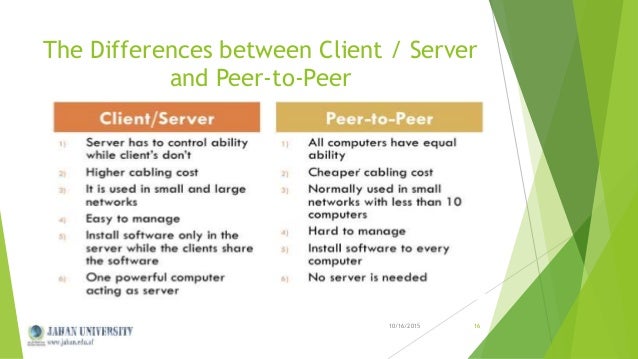
DIFFERENCES BETWEEN PEER TO PEER AND CLIENT SERVER NETWORK
Comments
Post a Comment